

 Google AI
 Businesses are increasingly offshoring their software development projects. This trend is predicted to increase this market’s CAGR by 10,13% by 2030, reaching $283 billion.
Mainly, high cost is the reason driving businesses to outsource. Therefore, offshore software development becomes particularly appealing.
This article unpacks the attractiveness of offshoring. Particularly, its pros and cons, the best destinations, and when to do it.
What is offshore software development?
Offshore development is a type of IT outsourcing, which means developing software using the services of a third-party vendor located in a remote location. It means the team you want to outsource your software project to is located outside your country’s region.
What IT services can you offshore?
60% of the US-based companies plan to outsource their software development in 2023. Software application development remains the most outsourced IT service.
When it comes to software offshoring, there is a wide range of services IT vendors offer. As mentioned, web and mobile application development are the most popular services.
At Sombra, we offer offshore discovery phase execution and outsourcing of particular expertise. Say you need a knowledgeable UI/UX designer to create an intuitive interface for a mobile app you’re working on. Our team will find one for you.
At the same time, we offer a managed team service. A highly-skilled team will take over your software project from start to finish.
Some businesses want offshore product maintenance, customer support, data storage, or security.
What is the Difference Between Onshore, Nearshore, and Offshore Software Development?
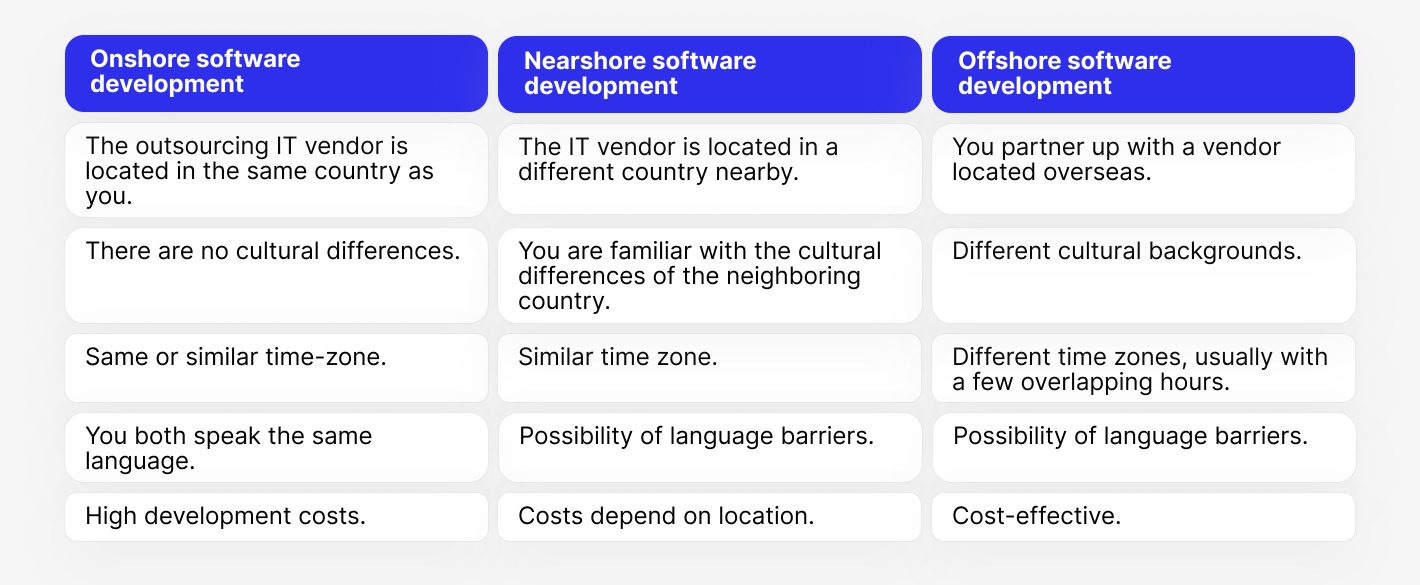
There are three outsourcing models: onshore, offshore, and nearshore.
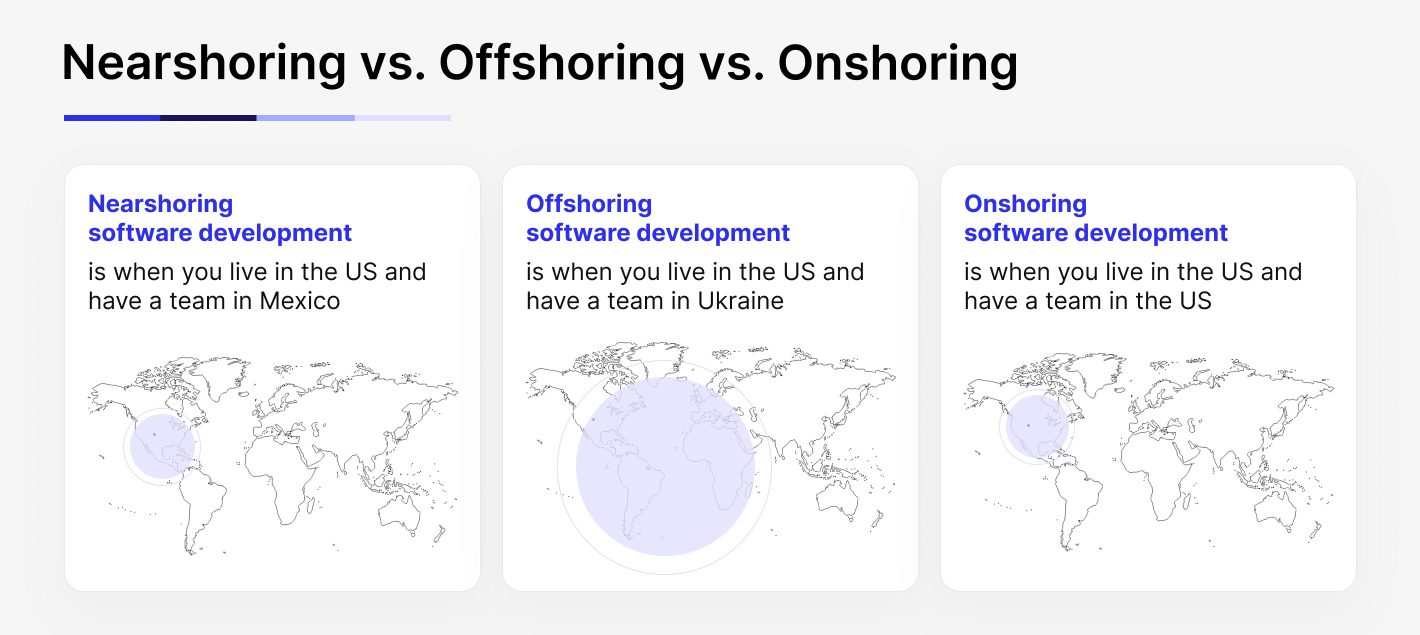
Types of outsourcing models
Let’s review the key characteristics of each model.
When to outsource software development?
There are four main reasons for businesses to consider offshore development outsourcing.
- Lack of expertise
Your in-house development team needs more specific expertise, like data engineering. - Scaling
Your product or business needs to scale its technical capabilities. - Staffing flexibility
Offshore development services allow you to hire offshore developers to- build entirely new software products,
- develop new features for the existing ones without disrupting your in-house team.
- Limited budget
If you have a limited budget, hiring an offshore team gives you access to a large - Limited budget
If you have a limited budget, hiring an offshore team gives you access to a large talent pool of highly skilled professionals at a lower cost.
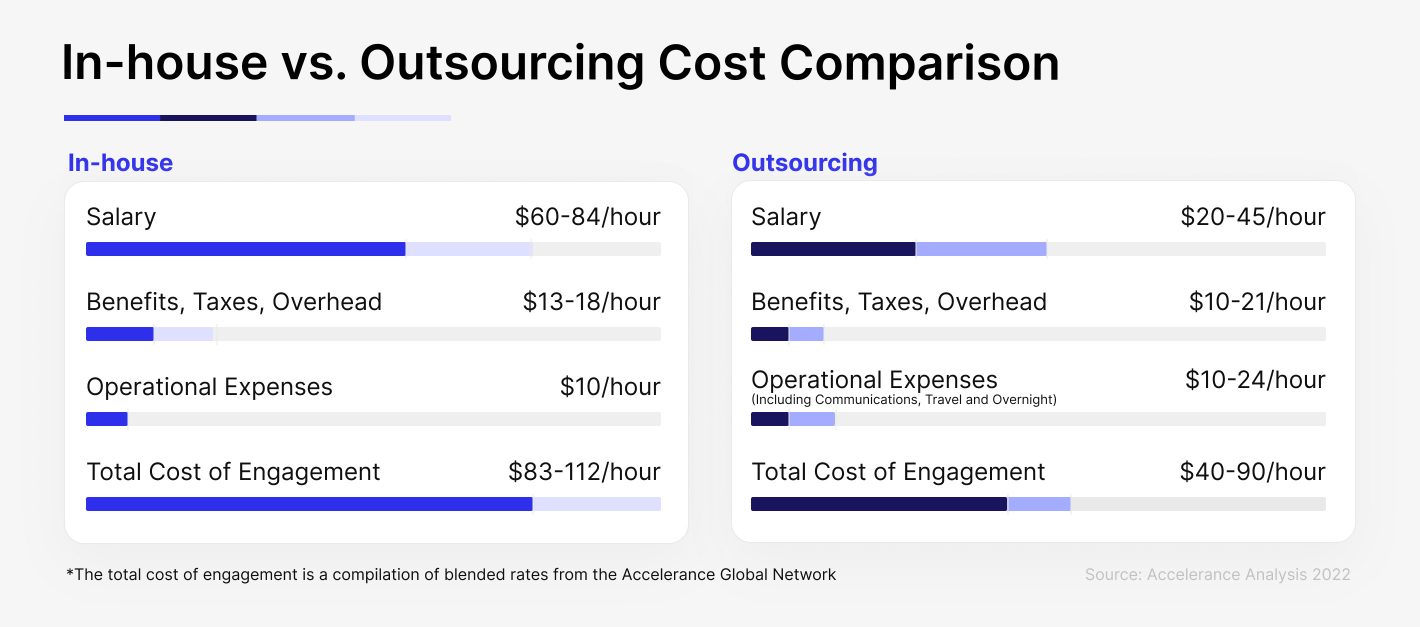
In-house vs outsourcing cost comparison
Benefits of offshore software development
The decision to offshore web or app development is usually a complex process. It requires analyzing the current business needs and offshore development pros and cons.
Software offshore development has the following benefits:
Reduced software development costs
After the pandemic, software development outsourcing has returned to its roots as a cost-saving method.
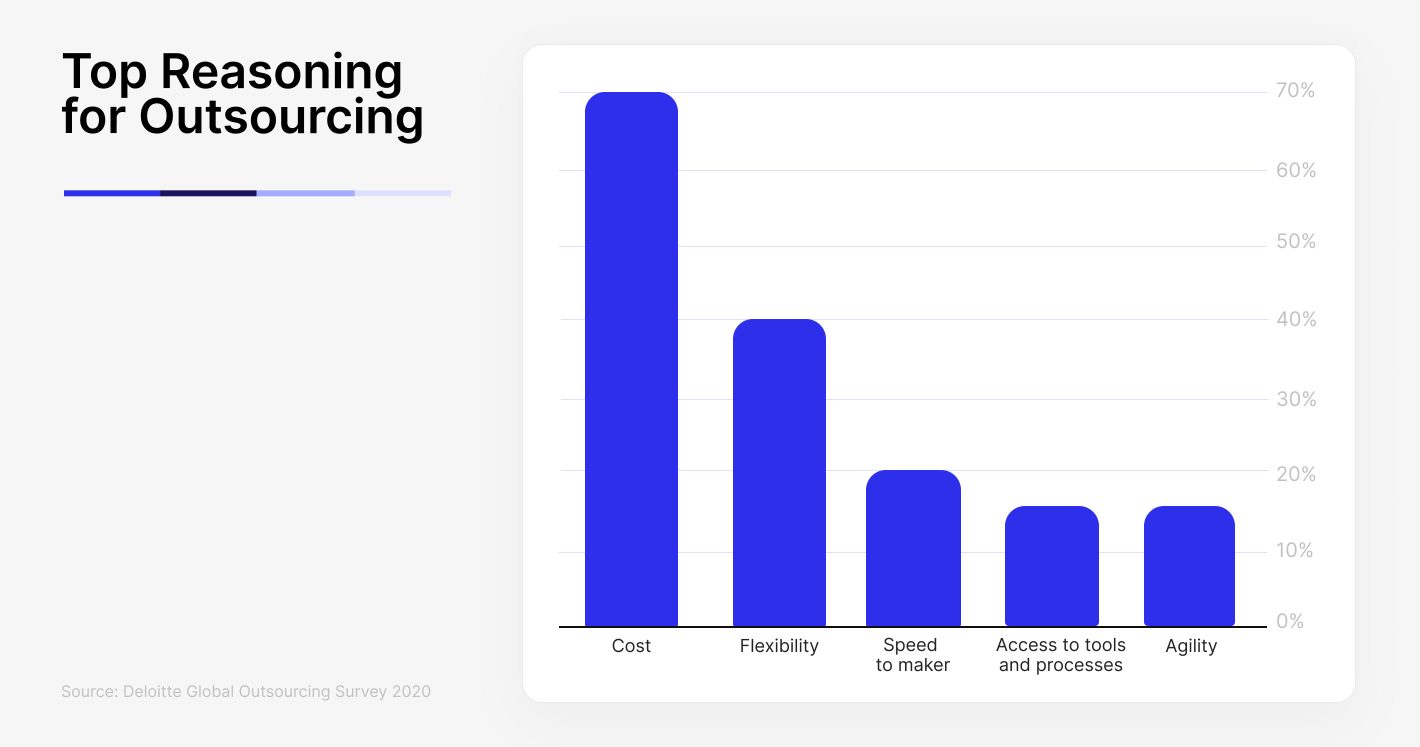
Top reasons for IT outsourcing
“Outsourcing levels are growing as more organizations take advantage of the cost flexibility that service providers offer.” – Computer Economics IT Outsourcing Statistics 2022
Partnering with an offshore software development firm can save a company 40% to 70% costs. Businesses can better control their expenses and budget due to lower costs than the US.
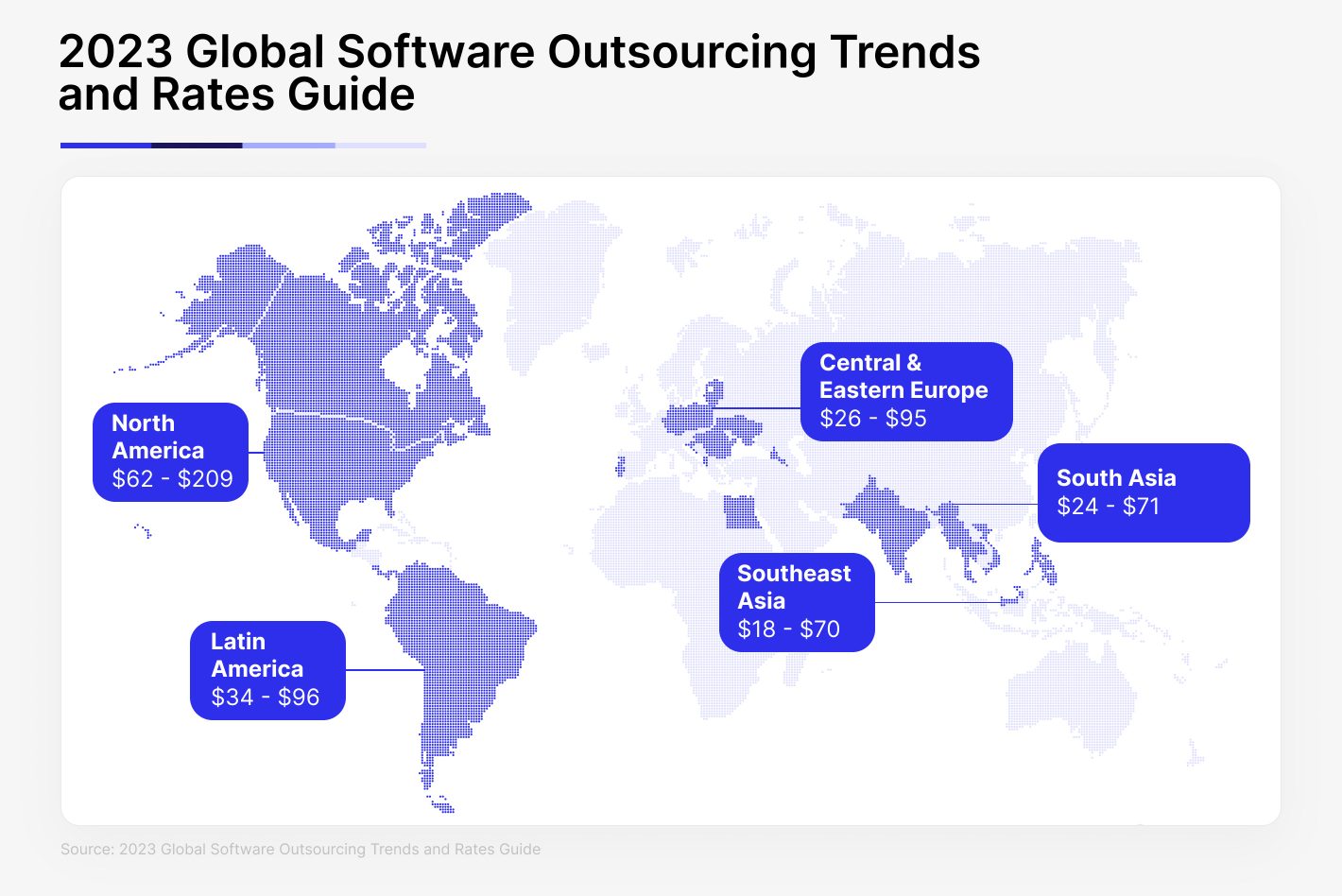
2023 Global software outsourcing rates
Access to a larger, skilled talent pool
69% of U.S. employers struggle to find skilled workers. Moreover, IT is among the top three the hardest positions to fill. Businesses looking to fill in-house gaps are turning to software outsourcing.
With offshore software development, businesses get access to a vast pool of talented and skilled engineers. Whether you need a Node.js expert or proficient programmers in less commonly used languages, the odds of discovering the ideal candidate are high within the offshore IT outsourcing regions.
Industry expertise
Filling in hyper-specialized development roles is a major 2023 outsourcing trend. Such roles involve fast-growing technologies such as artificial intelligence, cloud computing, and security.
It can be challenging to find a US-based developer specializing in a specific technology and industry at an affordable price.For example, Sombra has extensive fintech expertise. We have provided offshore custom software development services to one of the world’s top banks. We offer services in identity and asset management, digital wallet development, and more.
Scaling
Hiring offshore programmers adds more flexibility to scale your business up or down. Offshore software development models vary from managed team to staff augmentation. Thus, you can build a software development team to address your business needs.
Faster time-to-market
Time-to-market (TTM), or speed-to-market, is the time it takes from a software development project’s idea to its actual launch.
Decreasing your TTM allows you to grab a market share by getting there ahead of competitors.Yet, it is more than just being fast but delivering value to the clients.
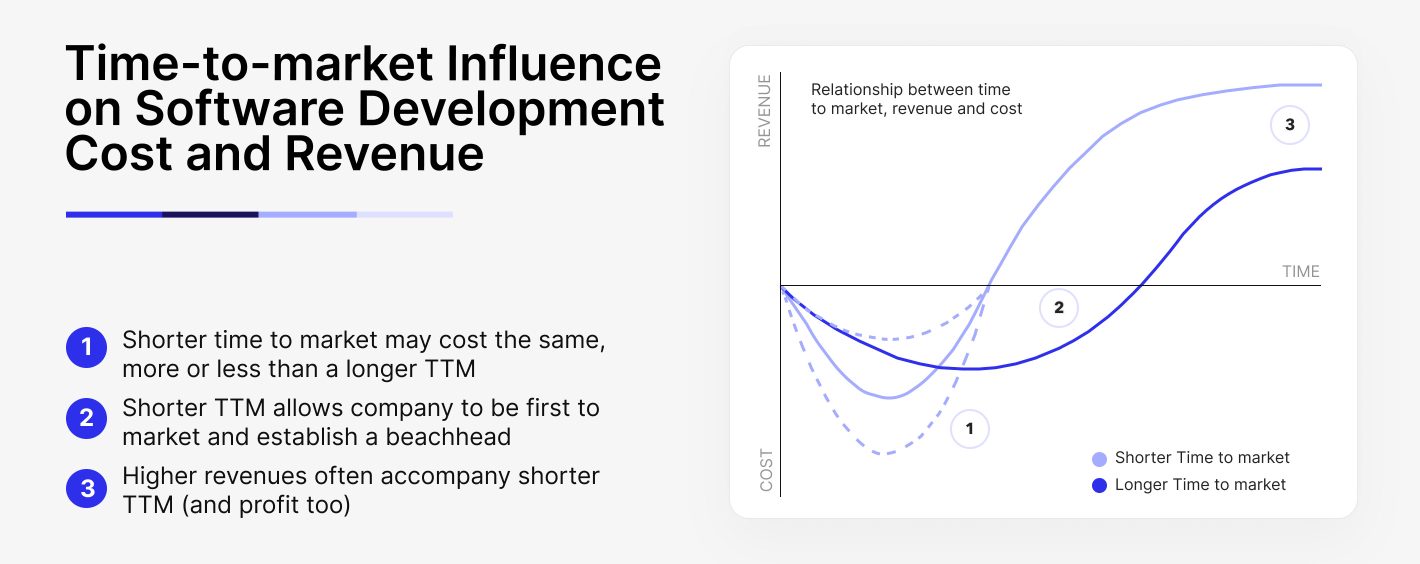
Time-to-market influence on software development cost and revenue
Time-to-market influence on software development cost and revenue
Offshore programming, in this case, helps your business to reduce the time-to-market by:
- Reducing costs. Keeping the development team small, if necessary. And without a long-term commitment to help cut your burn rate better.
- Increasing competitive advantage. Foster new, innovative technologies in a short time.
- Saving time. With strong management, you can ensure fewer revisions.
Minimize risks
Risk minimization mainly applies to non-technical companies, interested in strategic outsourcing. Fintech, medical device, and consumer packaged goods companies are the perfect examples. They want to develop innovative technology solutions or update the existing solutions with disruptive technologies, like robotic process automation (RPA.)
Hiring offshore means the IT vendor will contribute various skills. Offshore developers will likely be faster than the in-house team. Their dedicated resources can:
- accelerate project progress,
- reduce risks of overstaffing,
- reduce risks of increased burn rate.
Control over hiring
Recently, offshore software development couldn’t allow good control over hiring. So, it was considered a major disadvantage for offshore development outsourcing.
Now, stakeholders can have several interviews with the potential candidates during the recruitment.
Challenges of offshore software outsourcing
Offshore software product development has its flaws. Let’s review the main challenges and things a technical executive or founder should know.
Time difference
One of the main offshore challenges is the different time zones between the IT development partner and the client.
So, how does it affect the working process?
- Time zone difference slows down communication
- The software development process may be delayed at times when a critical issue arises or permission is needed
At Sombra, we often have overlapping work hours with our clients. We use this time to discuss all the clients’ concerns or questions.
Cultural differences
An Accenture study found up to 70% of 200 business executives from the United States admitted miscommunication based on cultural differences caused problems when outsourcing offshore. The main cultural factors that disrupt communication in software development offshoring are:
- Different communication styles
- Different approaches to task completion
- Different attitudes toward conflict
- Different decision-making styles
As a Ukrainian company located in Eastern Europe, Sombra shares much of the Western culture and values. Although some differences exist between our engineers and partners from the UK and the US, we are still culturally close.
A famous cultural dimensions theory by Geert Hofstede helps to analyze and compare different countries and their cultures against several vital factors. Using this framework helps get some insights into how offshoring software development can be successful.
For example, Ukraine scores 25 in Individualism. It indicates people in the country are more likely to focus on the group’s interests. Ukrainian developers are team players. They care about the well-being of their team.
Communication
When working with offshore software development teams, it’s important to consider potential miscommunication due to cultural differences and language barriers. Specifically, the poor English skills of an IT vendor can greatly impact the success of a project. To avoid project slowdowns, poor performance, and the need for revisions and reworks, it’s crucial to choose a vendor with strong English language skills throughout their team, from management down to the developers.
Security challenges
Offshoring software development carries a risk of data and code leakage, code vulnerability, and lack of security certifications.
Here are a few suggestions of what you can do to address this challenge:
- To protect yourself from intellectual property infringement in a form of code leakage, sign an NDA with your vendor.
- Choose SOC2 or ISO27001-certified IT vendors to avoid data leakage.
How to offshore software development in 6 steps
Finding an offshore service provider and launching the development process is demanding. In case you need help figuring out where to start, we offer you a six-step guide to follow you through.
Step 1: Identify your project requirements
Before contacting an offshore vendor, gather maximum information on the project. Define your objectives and identify what you need:
- a few people to strengthen your in-house team,
- outsource an entire project.
Depending on your needs, you’ll be considering staff augmentation or a dedicated team.
Step 2: Choose a reliable offshore vendor
Finding a suitable offshore software development company may take some time. The competition for software engineers is intense and can drive up costs by 30-50%. That is why you need to move fast but be smart about it.
- Do your own research and ask for references.
- Create a shortlist of candidates within a preferred location.
- Verify the candidate’s technical expertise. Read their reviews on platforms like Clutch. Check their LinkedIn or other social networks. A number of our clients came from previous partner references.
- Walk through their pre-sales process. This way, you’ll be able to know:
- What experience do they have with projects similar to yours?
- Ensure the potential partner’s company size suits your needs. An offshore development firm of a small size might not have enough resources to complete your project on time.
- Do they save time during the pre-sales process? How proactive are they in information gathering?
- Pay attention to how engaged they are in developing this partnership.
- How are they with uncomfortable questions during the pre-sales process?
- Take into consideration the impact of working across time zones. Talk about how they organize the working process in such conditions.
- Do they provide you with an escalation contact? What is this person’s influence/responsibility? What decisions can they make?
Step 3: Choose an offshore development model for delivery and pricing
After you’ve chosen an IT outsourced partner, you need to decide on a delivery model to fit your needs. There are two main offshore delivery models:
- Staff augmentation
With this delivery model, you hire offshore software programmers or teams to support in-house efforts.
- Dedicated team
This delivery model implies hiring an entire offshore software development team to run a project. This model can be helpful for non-technical organizations who are working on custom software solution development. The dedicated team will be responsible for the hiring and entire development process, as well as final delivery and results.
There are two major pricing offshore development models:
- Fixed price
Fixed-price contracts are commonly used for projects with a well-defined scope of work and clear requirements. This model is particularly suitable for small-to-medium-sized projects with predictable timelines. It incentivizes the offshore vendor to complete the work more efficiently, resulting in cost savings for the client. - Time and material (T&M)
This model suggests you pay for the actual amount of work based on the hourly rate of hired offshore software developers. This model is popular with companies relying on long-term cooperation because it allows more flexibility in the development process.
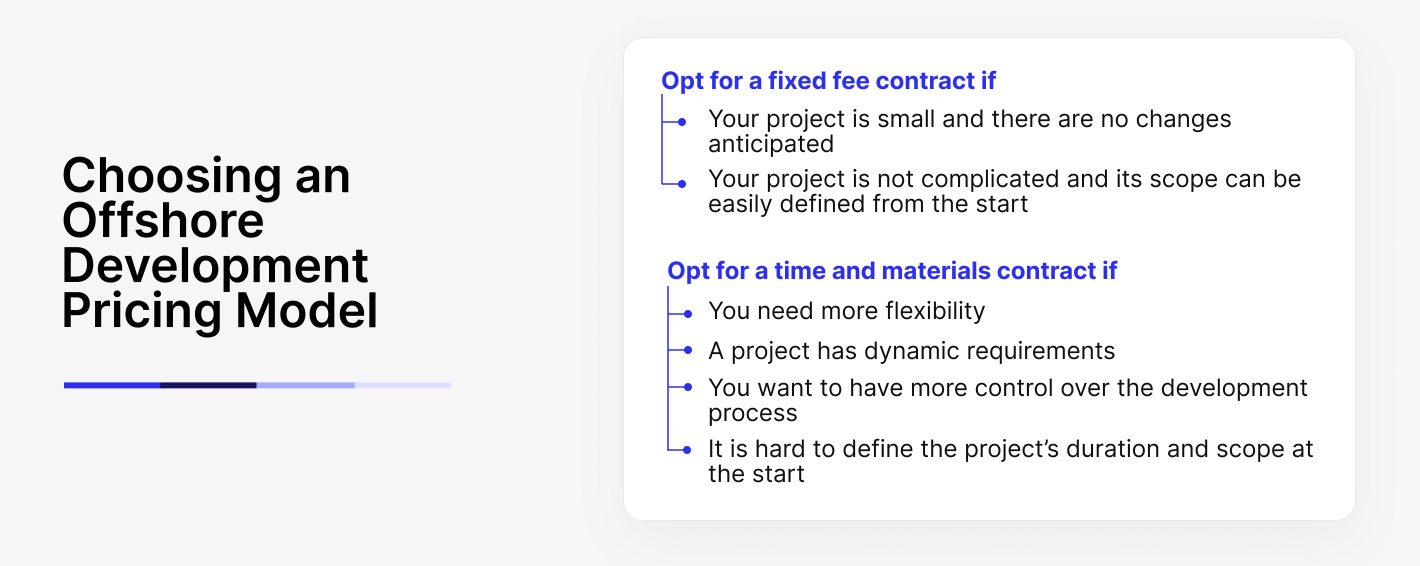
Guide to choosing an offshore development pricing model
Step 4: Choose communication tools
Offshore software development demands extra focus on communication. Otherwise, it can easily become a challenge, if not organized properly.
At Sombra, we use a set of tools to enhance our engagement and communication with the partners. We use Slack, Figma, Zoom, Google Meet, Jira, and Miro to build a transparent workflow with our clients.
Step 5: Give feedback
After you’ve established a clear workflow, the team starts working. When offshoring software development provides regular feedback and recognition to the team.
Step 6: Nurture partnership relations
There’s no secret to successful offshore software development. It still takes a team to deliver a project on time. When working with an offshore team, it is important to treat them as an extension of your in-house team in order to work effectively together.
The best countries for outsourcing software development
When choosing an offshore development outsourcing destination, you should consider several factors:
- Economic overview
- Does the country have a strong economy?
- How easy is it to do business there?
- How volatile is the local currency? (Sometimes, it is better to negotiate one of the major currencies as an accepted currency.)
- Talent pool
It is important to understand the state of the country’s education systems.- Do they have internationally recognized standards?
- What percentage of graduates earn a STEM degree?
- Do they have access to the latest technology?
- Can they use the latest technology in studies or work?
- Understanding of Western culture
- What is the English language skill among engineers?
- Do hired offshore developers understand a Western company’s and its customers’ needs?
- Have any of the senior staff studied or worked abroad?
- Legal system
Different forms of government have different efficiency levels in their enforcement of laws.- What is the current state of intellectual property ownership?
- How is civil law upheld?
- How compatible are the local laws with your domestic laws?
- Travel safety
If you want to visit your offshore programming partners, consider how safe it is to go there. Look up the current business travel policies, visa restrictions, COVID-19 policies, etc. - Political stability and western relations
Is the current government structure likely to remain stable during the entire period you wish to do business? Pay attention to any internal conflicts that may exist.- Does the country have a solid relationship with Western countries?
- Factor in any current or potential conflicts
- Time zone
-
- Is there a workday overlap?
Eastern Europe
Russia’s aggression caused a significant disruption to IT outsourcing in the region. Some Western clients left Ukraine, a key offshore development center for international firms.

Offshoring software development to Ukraine
Despite the turbulence, the region still has high offshore development potential. The IT exports reached
- 3.2 billion euros in Romania,
- 26 billion dollars in Poland,
- $7.3 billion dollars in Ukraine.
Moreover, the hourly rates in the Eastern European countries were not changed. Other offshore development centers such as Bulgaria, Croatia, and Romania are gaining more recognition.
The main cost-benefit of the region remains. You still can hire offshore software engineers for up to 30% less than on the US domestic market.
Ukraine
Offshoring development to Ukraine, known as the Silicon Valley of Eastern Europe, is still a choice international companies make. Offshore software development companies in Ukraine remain operational, working with remote teams moved to safe locations within the country or across the border.
Key factors to consider offshore software product development to Ukraine:
- Economic overview. In 2022, Ukrainian IT exports grew by 5.8%.
Ukraine still hosts over 90 international research and development (R&D) centers. Due to the russian aggression, inflation peaked above 30% in 2022 with rapid economic activity reduction. Yet, the return to growth is cautiously predicted for 2023 by the National Bank of Ukraine.
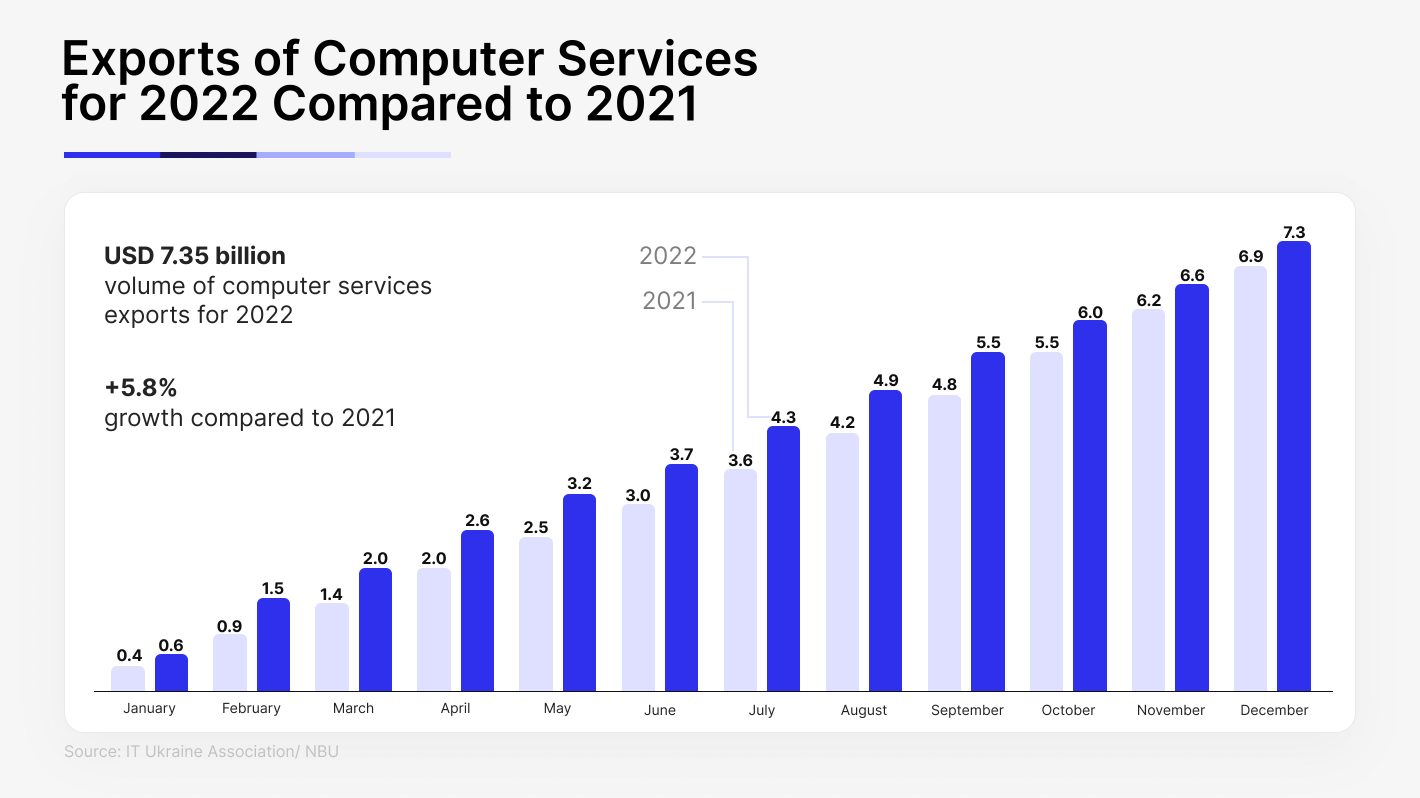
Ukraine’s IT export in 2022
- Tech talent pool. Ukraine’s tech talents count over 240,000 software engineers. According to Coursera’s 2022 report, Ukraine is in the top 25 for data science expertise.
- English proficiency. At least 80% of developers have an intermediate level of English or higher.
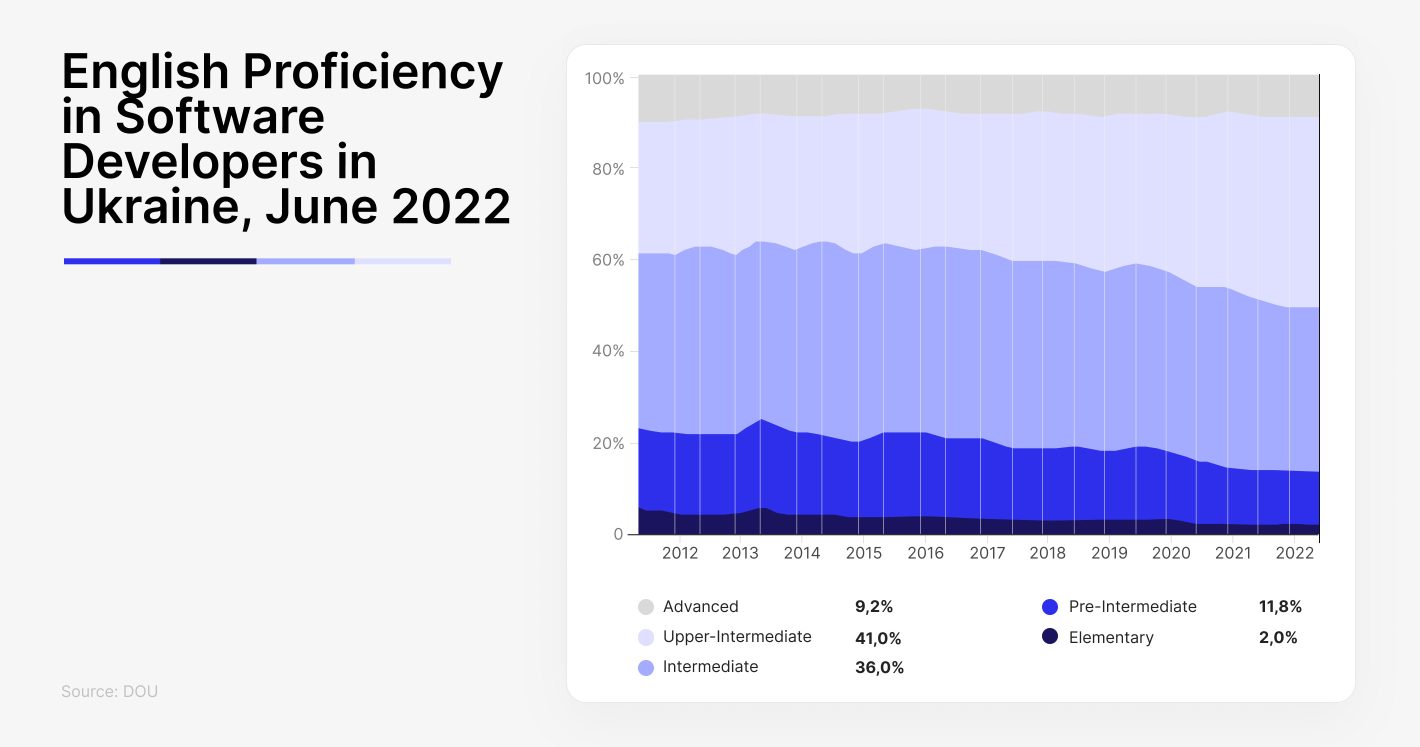
English proficiency in software developers in Ukraine, June 2022
- Market rates. Ukraine’s average offshore rates vary from $35/h to $45/h.
- Travel. Currently, there’s martial law in order in Ukraine. However, foreign citizens are allowed to visit.
- Time zone. Ukraine is 7 hours ahead of EST.
Sombra was ranked one of the top 2023 offshore managed service providers in Ukraine.

Sombra’s Clutch awards
Apart from that we proudly hold extensive expertise in Angular and Java development.
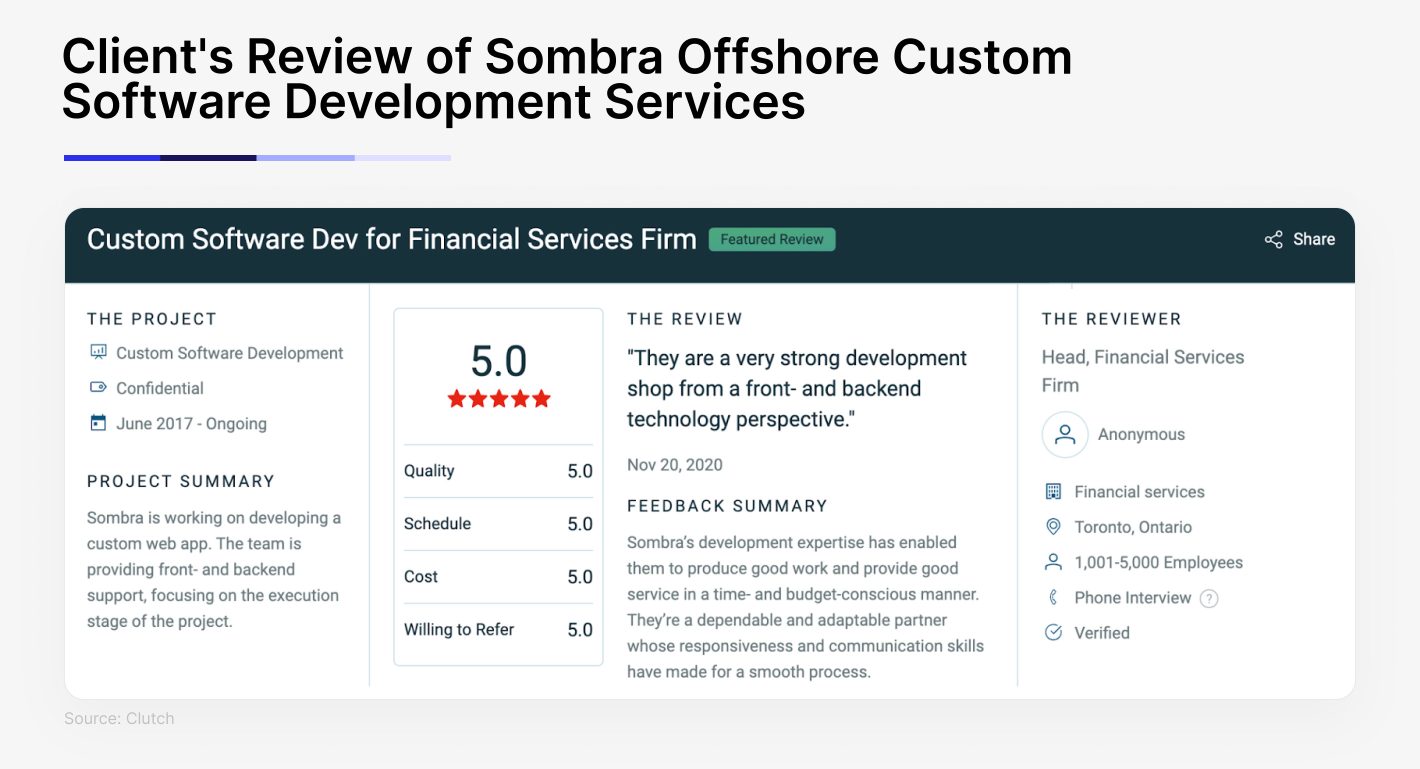
Client’s review of Sombra’s offshore custom software development services
Poland
“The IT sector in Poland has consistently ranked among the highest-paying industries for several years now,” says Piotr Sedlak, Ph.D. Project Manager / Managing Partner at Sedlak & Sedlak.
In 2022, foreign owners from EMEA or North America established over 600 software companies in Poland.
Key factors to consider offshore software product development to Poland:
- Economic overview. Polish GDP growth in 2022 reached 5.5%, according to Eurostat. Some Ukrainian software development companies also relocated or opened R&D centers, contributing to the development of the Polish IT market.
- Tech talent pool. Poland’s tech talent pool boasts over 360,000 software engineers and IT professionals.
- English proficiency. According to the EF English Proficiency Index, Poland has a very high English proficiency level, reaching 13th place on the list.
- Market rates. Poland’s average offshore rates range between $40-$55 per hour.
- Travel. 12-hr flight (one stop) from NYC.
- Time zone. Poland is 6 hours ahead of EST.
Contact us to explore all the benefits of offshore software development in Poland.
Latin America
The region can be considered both a nearshore and offshore development center. According to Accelerance’s Director of Partner Success Ryan Schauer:
“Right now, we are in the gold rush of software development. Our partners in Latin America are experiencing record demand, which can be seen through their hiring data. One partner has 200 open jobs recs to fill; another partner has more than 90 openings.”
Proximity for travel and overlapping time zones with the United States eases real-time communication, making Latin America an attractive outsourcing destination.
Countries like Brazil, Argentina, Chile, Colombia, and Mexico are driving the IT outsourcing industry in the region.
Colombia
Colombia joined the OECD in 2018 and is part of the CIVETS countries, which includes six up-and-coming economies. This group is praised for having a smart money system, stable prices, an increasing skilled talent population, varied exports, and more foreign investments. Colombia stands out as an appealing place for business in Latin America, with a culture influenced by the West and geographical closeness to the United States.
Key factors to consider offshore software product development in Colombia:
- Economic overview. The IT industry in Colombia is projected to reach $12.98 billion by 2026, with a CAGR of 8.8%. The Colombian government provides incentives and tax breaks for the IT companies operating in the country.
- Tech talent pool. Colombia has over 125,000 IT professionals.
- English proficiency. As per the EF English Proficiency Index, Colombia has low English proficiency. Yet, bigger cities, like Bogotá, earned themselves higher rankings of moderate knowledge.
- Market rates. Hiring offshore developers from Colombia will cost you on average $30-$50/h.
- Travel. 5.5-hr flight from NYC
- Time zone. Colombia is 0-1 hrs behind EST.
At Sombra, we fully understand businesses nowadays strive for resource diversification. That is why we also provide offshore software development in Colombia.
How Much Does Offshore Software Development Cost
A rough estimate formula for the offshore software product development budget estimation:
Software development cost = Engineer’s rate * Team size * Project duration
Considering the average rates for Ukraine ($35/h), Poland ($50/h) and Colombia ($40/h), here’s how you can roughly estimate the cost of software development:
Software offshoring development is mainly associated with affordable prices. As much as it is true, the final budget estimation for offshore software product development relies on:
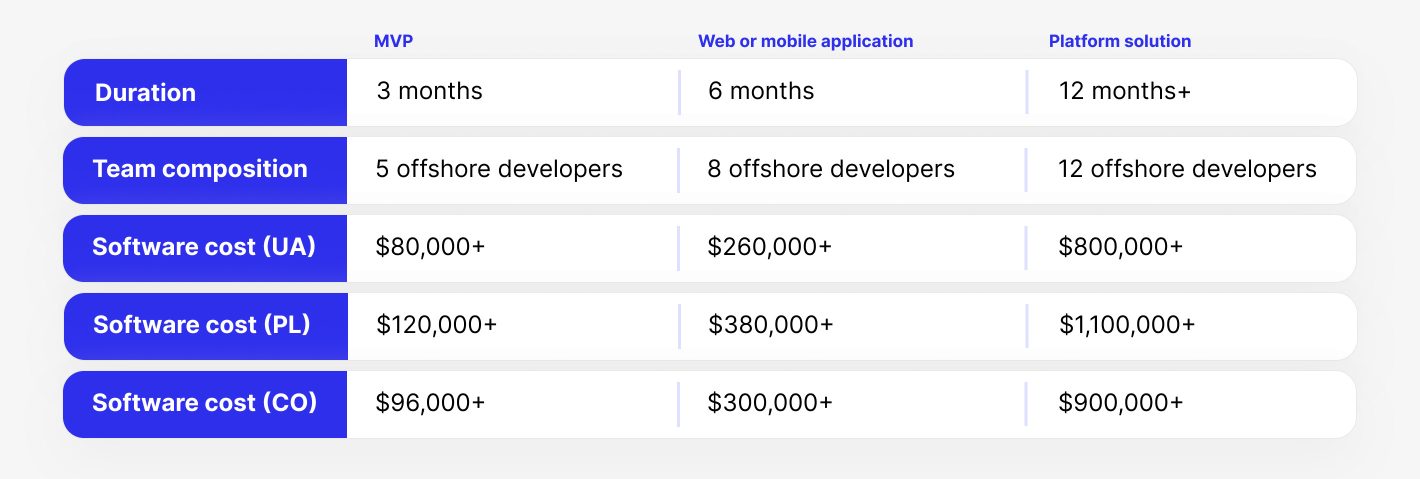
Offshore software development cost
- Software complexity. Advanced customization, a large number of screens, or performing heavy operations or analytics.
- Platform support depends on your target audience’s preferences using web, mobile, or both. At this point, you must decide to build offshore hybrid application development or focus on a particular platform.
- The UX/UI design complexity should not stand in the way of seamless software navigation and interaction.
- Tech stack directly affects your development budget. Niche technologies will drive prices up. Additionally, hiring hyper-specialized offshore developers will be challenging.
- Team composition factor in software development offshoring can be broken down to:
-
- engineers’ seniority level,
- the programming language used,
- location.
Why Offshore Software Development To Sombra?
Sombra is a professional custom software development company offering services to businesses based in the US, UK, and Canada. In 10 years, we’ve helped dozens of partners to achieve their business goals through leveraging modern technology.
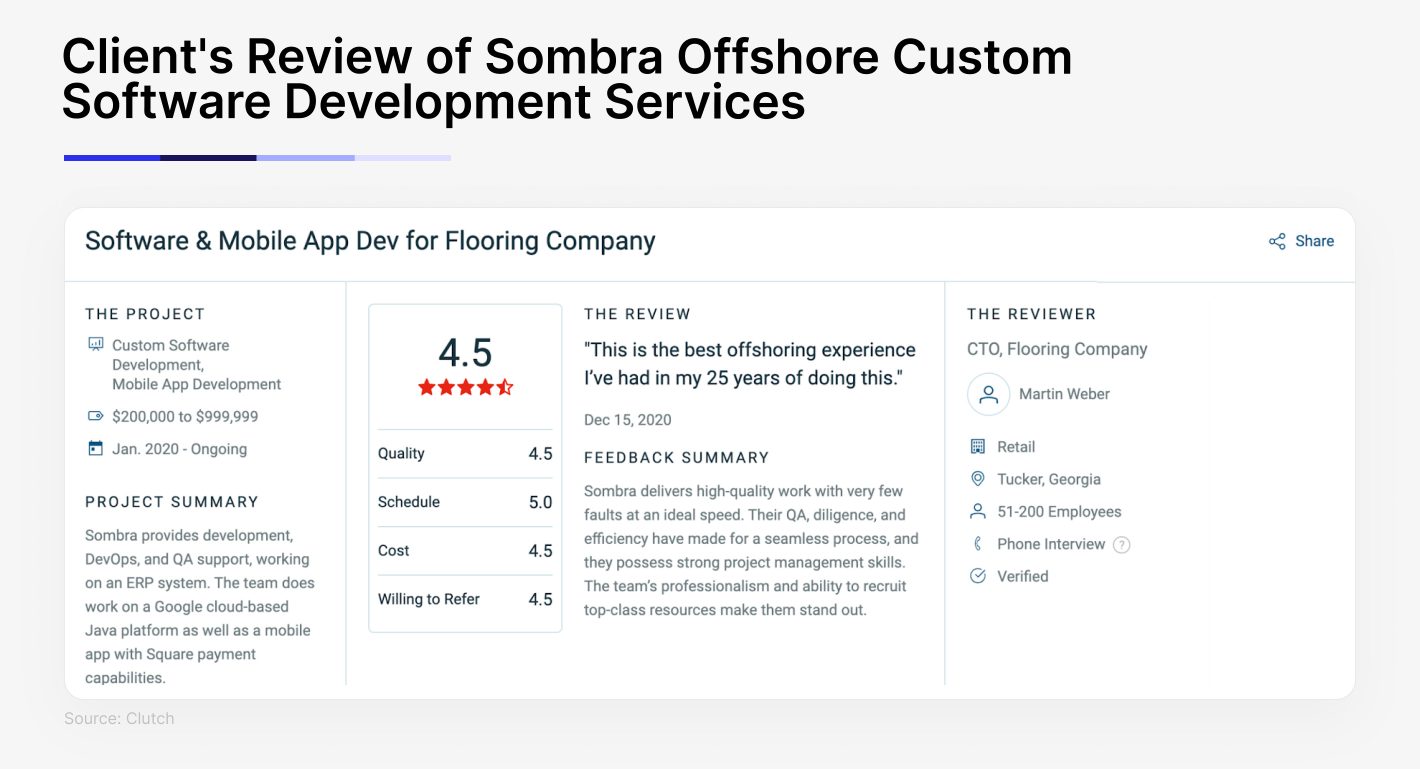
Client review on Sombra’s offshore software development services
We have great expertise in providing offshore software programming to our partners in finance, logistics, e-commerce, healthcare, and other industries.
Hire developers from Sombra
We’ve got you covered, from managed development teams to individuals. We can find experts providing in-depth expertise in front end, back end, BA, product design, DevOps, QA, and data engineering. Sombra is capable of covering your entire software development process.
Moreover, we’ve carefully crafted our recruitment process to meet our partners’ expectations regarding offshoring software development.
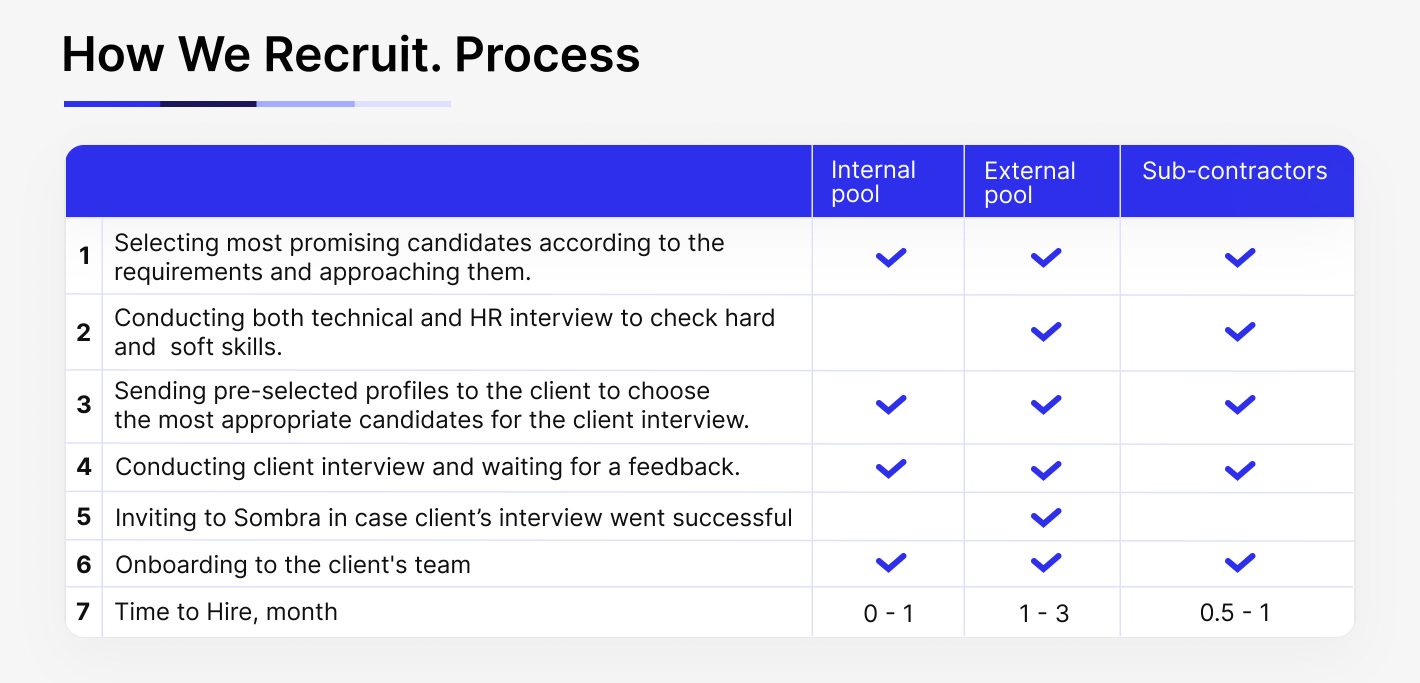
Sombra’s software engineer recruitment process
We study the benefits and challenges of the talent pool. Then guide clients toward hiring the best offshore developers to meet their project’s needs.
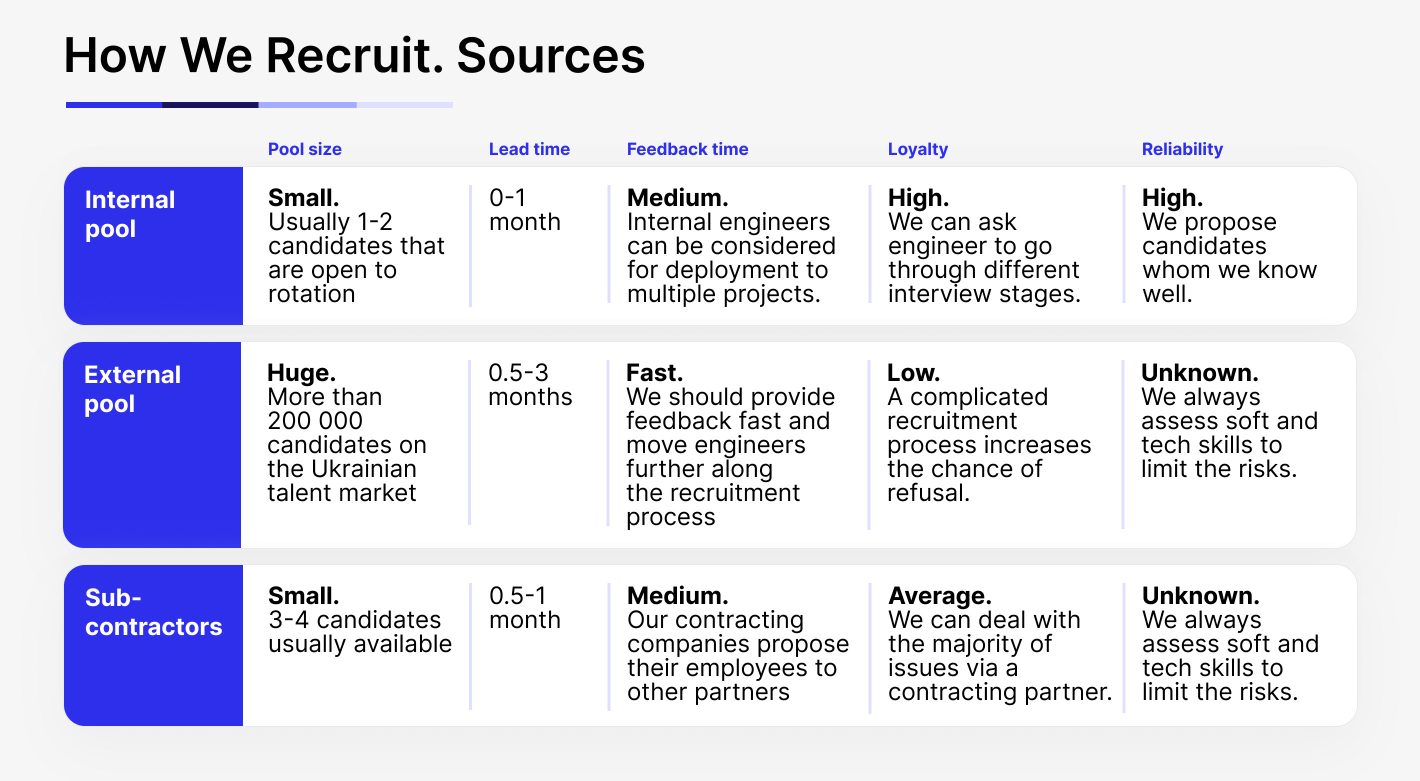
Sombra’s hiring sources
Contact us if you want to start your next offshore software development with a reliable service provider. Sombra representatives will happily answer your questions. They will guide you through how outsourced custom software development can boost your business.
Final thoughts
Offshore software development is a process of outsourcing software development to a foreign IT vendor.
The difference between onshore vs. offshore outsourcing lies in the vendor’s
- location,
- time zone difference,
- labor cost,
- English knowledge.
Offshoring software development has pros and cons. Among the advantages of offshoring software, there are:
- Access to a larger talent pool
- Reduced development costs
- Development process flexibility and software scaling
- Decreased time-to-market
- Control over hiring
- Industry-focused expertise
Disadvantages include:
- Time difference
- Cultural differences
- Communication challenges
- Security challenges
To offshore product development, you have to
- Determine project requirements
- Find a trusted vendor
- Choose an offshore development model
- Agree on communication tools
- Set up regular communication
- Nurture partnership relationships
The best offshore development companies are located in Latin America, Eastern and Central Europe. The benefits of outsourcing to these countries outweigh the disadvantages.
So, hiring, for example, offshore mobile developers is times more cost-effective than finding a US-based talent. Additionally, you can expect superb quality.
As a result, offshoring a web or mobile app development will cost you between $160,000 and $220,000. In the US, the price for app development is likely to surpass $550,000. The final estimates depend on the architecture and design complexity, team composition, and more.
Ready to explore offshore software development for your business? Get in touch with our team to discuss your project and see how we can help you reduce costs, speed up delivery, and scale with confidence.